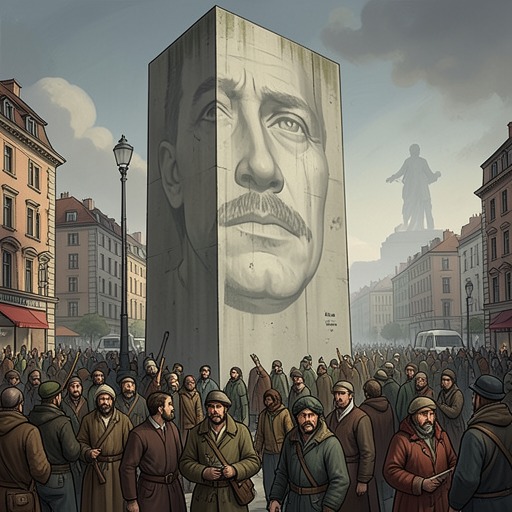
François-Joseph Ier, 70e anniversaire de naissance
Felix AustriaFrançois-Joseph Ier, 70e anniversaire de naissance is the public celebration of Emperor Francis Joseph I’s seventieth birthday in Stanislaviv in August 1900. In the novel, the anniversary brings together ceremonial loyalty, Stefania’s practical act of care, and a broader belief in the stability of the Austro-Hungarian Empire—a belief that the surrounding evidence of hardship and political conflict, and ultimately the collapsing Anger house, render precarious.
Date and public meaning
The celebrations are framed as an event shared across the monarchy. A newspaper account dated 19 August 1900 says that the peoples of Austria-Hungary are marking the emperor’s seventieth birthday and presents him as an exceptional ruler and protector. Its account of Galicia’s past is pointedly political: it recalls the region’s material destruction, moral humiliation, and cultural neglect under earlier rule, then credits the emperor with recognizing its worth and allowing it a voice in state affairs and freedom to develop. The anniversary is therefore not simply a birthday observance; it is also an argument for loyalty, grounded in a claimed change in the relationship between Galicia and the Crown.
The narrator’s voice makes that public reverence intimate and personal. On the eve of the holiday she cannot sleep, describing the emperor as the wise father of many peoples. Petro questions Stefania’s enthusiasm, but she answers that the emperor’s birthday comes only once a year. Her explanation is brief, yet it conveys how the official occasion enters the household through food, conversation, and the work of preparation rather than through political speech alone.
The city’s ceremonial route
The newspaper reports that Stanislaviv had been decorated with flowers and banners well before the anniversary, giving it an unusually solemn appearance. The festivities opened with a military procession under the direction of Dr. Konkolniak, the deputy mayor. Railway musicians from the Harmony orchestra, volunteer firefighters arriving from Kniahynyn-Colonia, and a crowd of townspeople joined the parade, which set out from the barracks at 8:30 p.m.
Its route carried the procession through the city’s civic and commercial landmarks: along Sapieżynska Street, past the municipal building and the Krona restaurant, then through Sobieski, Gołuchowski, Issakowycz, and Linden streets, with a stop near General Boineburg and Lieutenant Field Marshal Malowetz. From there it continued past the bishop’s residence and, after further streets and a halt at the Market Square before the town hall, returned to the barracks by way of Kraszewski Street. The itinerary maps imperial ceremony onto ordinary urban space, making the city itself a stage on which authority and communal participation appear to move together.
Stefania, Adèle, Petro, and the boy are caught up in the procession’s crowd. Adèle wears a high-waisted sky-blue dress and violet water; Petro is uneasy because he dislikes such events; Stefania carries the child in her arms as he plays with a lock of her hair. The narrator describes the crowd as drawing them along like a river. Their presence gives the formal parade a domestic, bodily scale: they are not detached spectators but a household swept into the public celebration.
A holiday turned toward the prisoners
The anniversary also gives Stefania a reason to make more food than the household can use. Through the night she prepares trays of cream-filled pastries, working at the stove while the boy rests behind it. When Petro finds her still awake, she insists that the emperor’s birthday is not an everyday occasion. The quantity of baking soon exceeds the available baskets, so she packs the remainder into large boxes ordinarily used for carrying mushrooms and vegetables and hires a coach rather than trying to transport everything by bicycle.
Stefania takes the food to the prison. Father Josef is waiting outside, dishevelled and sleepy but cheerful and surprised; he helps unload the baskets and boxes. When he asks whether she has baked for an army, she explains that the pastries are for the prisoners too, because she had heard them singing the previous Sunday and wants them to have a celebration as well. His eyes fill with tears, but he does not manage to say what he had intended. Stefania understands his response without requiring him to put it into words. The scene redirects the holiday’s abundance away from imperial display and toward people confined beyond the household and parade route.
Pageantry and the cracks in the imperial image
The celebratory language of unity exists alongside a city sharply divided by material conditions. In the poorer, narrow lanes, imperial portraits and the double-headed eagle hang above filthy courtyards and crumbling conditions; the slogans Indivisibiliter Ac Inseparabiliter and Felix Austria are displayed even there. The juxtaposition does not erase the force of those emblems, but it sets their promise of indivisible harmony against visible deprivation. The anniversary’s polished procession and the crowded lanes belong to the same urban world.
Political debate likewise complicates the image of a secure and benevolent order. At a later gathering, discussion of municipal and parliamentary elections becomes heated, with accusations of conspiracy and fraud and anger that some people cannot vote under the country’s laws, or will not gain that right for years. In another conversation, Petro questions the language used to describe the powers’ intervention in China, which Russia insists should not be called a war. The novel places imperial celebration beside disputes over political voice and the euphemisms by which military action is presented as benevolent. The birthday’s rhetoric of protection and shared belonging is therefore not the only account of power available in the story.
The anniversary in the novel’s hindsight
The historical atmosphere is one of transition as well as commemoration. The narrator describes a modern city of electric light, photography, telephones, X-rays, and changing scientific explanations, while observing that new technology and knowledge are arriving faster than people can absorb them. The anniversary takes place within this unsettled world: imperial ceremony offers a language of continuity at a moment when both scientific understanding and political arrangements are changing.
The novel’s strongest retrospective irony comes when Stefania imagines her love as enduring and unchanging, like the Austro-Hungarian Empire. That comparison gives private feeling the scale of a political promise. During the fire at the end, the house’s unusual furnishings melt and disappear; amid the smoke, Stefania recognizes that she has lived in an illusion. The birthday procession cannot by itself predict that ending, but its celebration of imperial permanence gains a tragic counterpoint from it. The anniversary records what the city wanted to affirm in 1900, while the novel’s later destruction exposes the fragility hidden inside that affirmation.